







Football and Malvinas: An Indestructible Connection
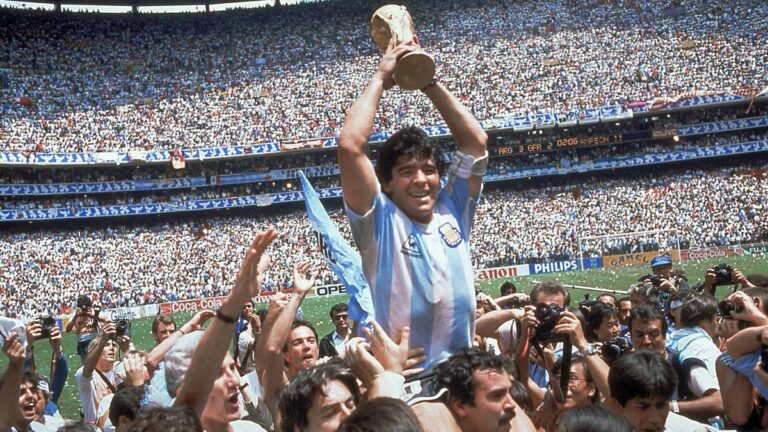
(FILE) Diego Armando Maradona with the World Cup that the Argentinean team won in Mexico 1986. Photo: AP.
April 2, 2026 Hour: 8:20 pm
🔗 Comparte este artículo
Every April 2nd, Argentina commemorates the Day of Veterans and Fallen Soldiers in the Malvinas Islands War, a date where football and memory are indestructibly intertwined.
Even during the 1982 conflict, in the trenches of Port Stanley, the cold and anguish were fought by tuning into national team matches on portable radios or playing improvised “picaditos” (small, informal games) in the mud with rag balls and helmets as goalposts.
For those young soldiers, football was the only lifeline that brought them back, at least for ninety minutes, to the fields of their homes.
From Military Manipulation to the Weight of Reality
In contrast to the purity of that refuge, sport was also used as a distraction by the civil-military dictatorship, which even planned an unusual Superclasic between Boca and River on the islands or organized charity matches whose millionaire funds never reached the combatants.
This climate of total confusion heavily impacted the national team at the 1982 World Cup in Spain; the team debuted against Belgium just one day before Argentina’s surrender, playing with the heavy emotional burden of knowing that young people their age were losing their lives on the battlefield.
Mexico ’86: A People’s Spiritual Revenge
The true turning point and catharsis in this story occurred on June 22, 1986, at the World Cup in Mexico. Diego Armando Maradona’s historic goals against England transformed a quarter-final match into a national catharsis and a “spiritual revenge,” as the Argentine star himself stated.
That victory did not change the territorial reality or bring back the fallen, but it served as an unforgettable balm of dignity for a wounded people.
A Cry for Sovereignty That Lives On in the Stadiums
Today, Argentine football stadiums remain the most faithful guardians of that sovereignty through popular chants, with the hit “Muchachos” at the forefront, and the institutional tribute of clubs to their veterans.
Football and the Malvinas share an unbreakable cultural bond that keeps memory alive under a single premise of national identity: that neither the ball is stained, nor the islands are forgotten, with the latent dream that one day a “picadito” will be played again on Malvinas soil.
Author: DR-JDO
Source: teleSUR